Discover Books
Browse 20 books from talented authors
Results ranked by relevance — combining recency, engagement, reviews, and profile completeness. Authors with active subscriptions receive a ranking boost. Learn more
Loading books...

Browse 20 books from talented authors
Results ranked by relevance — combining recency, engagement, reviews, and profile completeness. Authors with active subscriptions receive a ranking boost. Learn more
Loading books...

The Wedding, The Funeral by Davis Morena Motaung is a "Relational Realism" novel set in the vibrant township of Vosloorus, South Africa. It explores the "Geometry of Integrity", the complex ways human beings define their worth through tradition, status, and community.Core ConflictThe story centers on a high-stakes collision between two neighboring households representing opposite poles of the South African dream:- The Khumalos: Driven by "Sandton" aspirations, they view integrity as a currency of wealth and curated digital image. They are preparing for a massive, "international" wedding designed to rebrand their family status.- The Mokoenas: Rooted in the "Geometry of Tradition," they value ancestral bloodlines, cultural protocols, and long-standing community respect. They are suddenly plunged into mourning following the death of their matriarch.The "impossible overlap" occurs when the Khumalo wedding and the Mokoena funeral are scheduled for the same Saturday on a narrow street that only has room for one.Key Characters- Thabo Khumalo: The patriarch who uses corporate diplomacy and "executive" posturing to mask a twenty-year-old grudge.- Sipho Mokoena: The eldest son who defends his family's dignity against what he perceives as the Khumalos' "invasive aesthetic".- Junior Khumalo: The groom whose "Global Citizen" act collapses under the weight of the weekend's absurdity.- The Gossip Queen (Lerato): A neighborhood observer who livestreams the escalating "Tent Wars," turning the private feud into a "national embarrassment".Plot StructureThe narrative unfolds across several distinct phases of escalation:- The Build-Up: The Khumalos' frantic, industrial-grade wedding preparations collide with the Mokoenas' sudden tragedy.- Territorial Warfare: Minor disputes over parking, electricity, and noise escalate into a "Line in the Sand" drawn in the neighborhood WhatsApp group.- Public Humiliation: High-status guests from Dubai and London are forced to witness the "Human Signature" of a township funeral.- Total Madness: The conflict peaks during the "Cow Incident," where a funeral animal destroys the wedding's "Architecture of Appearance," and a "Convoy Collision" occurs when the silver hearse and white limousine meet bumper-to-bumper.- Resolution: The "Accidental Harmony" occurs when the two families' choirs begin to sing together in the dark. The story concludes with the two patriarchs finally reconciling over a borrowed ladder, the same object that sparked their rivalry decades earlier.Major Themes- Authenticity vs. Appearance: The novel critiques the performance of wealth and the "Sandton" mask, suggesting true dignity is found when these masks slip.- The Weight of the Past: A 2006 incident involving a borrowed ladder serves as the "Residue" that fuels the current conflict, showing how unhealed community wounds persist.Shared Humanity: Despite their differences, the characters eventually find common ground through shared laughter, collective integrity, and the "Ordinary Reality" of township life.
Published 2026
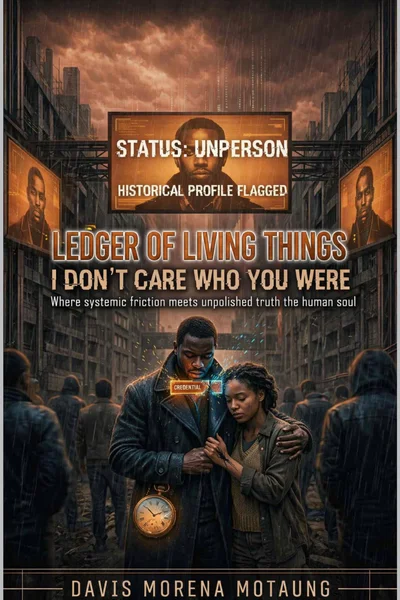
Ledger of Living Things: I Don’t Care Who You WereBy Davis Morena MotaungThe Core HookWhere systemic friction meets the unpolished truth of the human soul. A powerful narrative of radical transparent presence, identity sovereignty, and the terrifying permanence of the digital footprint.The Summary: A Sanctuary in the Gravity of the Right NowThe city does not sleep; it calculates. Beneath a low, iron sky, fiber-optic nerves pulse behind concrete walls, indexing the worth of every soul. Citizens are heavily taxed by the compounding psychological wear of projecting a flawless, engineered persona just to survive. The past has absolute gravity; the archives hold the dead weight of yesterday’s mistakes, forcing individuals to carry past failures into every room they enter.Silas, an elite field analyst within the Ministry of Records, has spent ten years mastering this persona tax while hiding a forgotten debt. But when an algorithmic audit runs a deep search query, his safety dissolves. The terminal flashes: Historical Profile Flagged. Shifted from an invisible face to an endangered liability, Silas faces an administrative trap designed by Director Vance. He is offered a smooth escape hatch: reallocate his discrepancy to Marcus, an innocent, aging archivist, to wipe his own ledger clean.Refusing to destroy a colleague, Silas executes a dangerous performance of data defiance, injecting a corrupted data-loop to shield Marcus. The retaliation is absolute. During the morning broadcast, a public execution of Silas’s digital identity occurs. Reclassified as an unperson, he becomes a ghost driven into industrial tracking blind spots.His only anchor is Eden, a defiant archivist whose unbuttoned jacket, hand-knitted vest, and ink-smudged palm represent a refusal to smooth over the cracks of human nature. Together, they seek refuge in hidden, analog spaces. But the system is closing its dragnet. Senior Arbiter Kross arrives with a final ultimatum: betray Eden’s secret repository of unauthorized historical archives to fully restore his citizenship, or face permanent banishment. Silas must decide if survival is worth the total surrender of his sovereign humanity.The Deep Lore of the Sovereign GridThe Persona Tax: The psychological energy expended daily to maintain compliance. Sensors measure behavioral turbulence; an irregular stride is calculated instantly as a data anomaly.The Ledger: A sterile database treating human value as a balanced equation. A variance in one entry must always be filled by a metric from another soul to maintain equilibrium.The Fractal Motif: A damaged mechanical pocket-watch with a fractured crystal face. Its brass gears hitch every three seconds, serving as a physical manifestation of an identity refusing institutional synchronization.The Social Contagion Loop: When an entity is flagged, their social circle initiates immediate data-quarantines to avoid contamination, leaving the pariah exposed in non-recognition.Literary Architecture & FrameworkRooted firmly in the principles of Relational Realism, this novel explores the thresholds of human accountability and integrity. Author Davis Morena Motaung avoids sterile conventions, delivering a rich, evocative African Dark Academia aesthetic. By weaving deeply philosophical storytelling with a visceral, high-contrast atmosphere of wet asphalt and cold concrete monoliths, this book serves as an urgent invitation to anchor oneself in the raw sanctuary of the present breath.
Published 2026
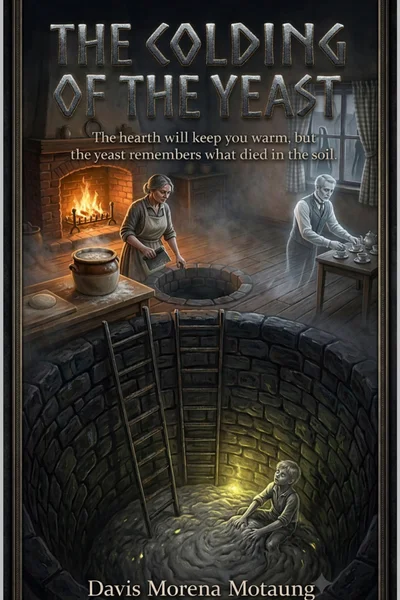
The Colding of the YeastThe hearth will keep you warm, but the yeast remembers what died in the soil.On a desolate, winter-locked homestead, survival demands absolute focus. Inside, the scent of rising dough fills the kitchen, and a blazing stone hearth offers a deceptive sanctuary from the biting cold. But this warmth is merely a fragile veneer. Beneath the floorboards lies a dark, stone-lined well, a claustrophobic pit filled not with water, but with a thick, living, bioluminescent yeast that churns in the shadows with an unsettling, organic heat.The household's fragile peace shatters when a young boy tumbles over the lip of the well. Trapped in the suffocating, glowing mass, his struggles draw him deeper. As he sinks, he discovers the yeast is no mere biological anomaly; it possesses a collective, tactile memory. It preserves the exact impressions, final moments, and unspoken truths of everything, and everyone, that has ever died in the surrounding soil.As the boy fights for breath in the depths, the world above warps. The internal tension grows suffocating as a spectral presence manifests beside the table, silently performing the routines of a life long ended. Outside, dark, silhouetted figures gather in the frozen mist, watching through frosted windowpanes. They do not knock or storm the doors; they simply wait, an inescapable manifestation of a looming reckoning.The Colding of the Yeast is an intense, atmospheric narrative where the environment holds a grudge. Bound by the strict laws of human accountability and the weight of past choices, the family must confront the secrets they buried. It is a haunting tale of psychological isolation and relational consequence, proving that what is committed to the earth will eventually rise to demand its due.Appendix: Core Lore DocumentationI. Environmental Mechanics: The Well and The Mass1. Thermal Inversion: The homestead exists in extreme climatic contrast. While the surface is locked in a freezing winter, the deep, stone-lined well generates its own localized, organic heat. This creates a psychological division: the hearth represents the deceptive comfort of the present, while the pulsing pit represents the inescapable reality of the past.2. The Bioluminescent Ledger: The thick yeast mass inside the well acts as a biological archive. It does not merely decompose organic matter; it absorbs and preserves the sensory, physical, and emotional impressions of any living being that perishes in the local soil.3. The Displacement Trap: The physical properties of the living yeast function like quicksand. The substance is highly viscous; any kinetic struggle or downward force causes immediate displacement, pulling trapped individuals rapidly into its suffocating depths.II. Manifestation Guidelines· The Spectral Echo: The presence within the domestic space is entirely non-violent yet deeply disruptive. Rather than acting with overt malice, it performs mundane, everyday routines, like sitting at the table or tending to empty chores, symbolizing the breakdown of boundaries between buried secrets and daily life.· The Window Silhouettes: The dark figures gathering in the frozen mist outside remain completely stationary and silent. They do not attempt to breach the home by force. Instead, they operate as an active pressure point, representing a looming, inevitable reckoning that forces the characters inside to turn inward and face their unresolved relational debts.
Published 2026

1 of 2
Hidden Depths“The man who builds a house on a shadow must eventually learn to sleep standing up.”In an era where every digital footprint is permanent and every memory can be forensicly restored, what is the true cost of a clean slate? Hidden Depths is a haunting exploration of the “Architecture of Silence”, the elaborate structures we build to house the versions of ourselves we have deleted to survive the journey.The Premise The series follows Godfrey Kumalo, a man of “quiet intensity” and a pillar of academic integrity. To the elite circles of Johannesburg, he is a masterpiece of curated neutrality; to himself, he is a man living in the crushing space between two names, two families, and two truths.Godfrey has spent decades meticulously scrubbing his past to build a life of luxury and tenure. He has traded the red dust of his rural village for silk ties and sandalwood-scented hallways. But in the world of 2026, the past is never truly buried; it is merely dormant, waiting for the right algorithm to summon it back to life.The Conflict: The Weight and the Ghost The series introduces a grounded, "hard magic" psychological element known as “The Weight”. Every time Godfrey commits an act of erasure, every time he signs his legal name or burns a memory of his first wife and child to pass a background check, his shadow thickens. It becomes a semi-solid "oil slick" of ink-black density that physically pulls at his frame and causes the floorboards of his perfect life to splinter and crack.This internal "Shadow’s Debt" becomes a public liability when two worlds collide:The Digital Ghost: Elena, Godfrey’s wife and a master archivist, unknowingly begins a "Restoration Tribute" using advanced AI tools. She begins "healing" corrupted 2008 server files, rendering Godfrey’s original life in terrifying 8,000-pixel clarity.The Physical Indictment: Jabari, the son Godfrey abandoned and re-categorized as a "distal relative" to pass citizenship protocols, arrives from the village. Jabari is a walking forensic audit, carrying the same "iron in his blood" that Godfrey tried to delete.Themes of Integrity and Erasure At its heart, Hidden Depths asks a singular, haunting question: If you could erase your greatest regret at the cost of your most precious memory, would you?The series deconstructs the "Humanization Protocol" of modern society, the masks we wear and the "ugly" fragments of truth we hide. It explores the "Double Bind" of survival: the more Godfrey deletes his past to protect his future, the more he turns himself into a machine, an "Empty Jar" devoid of the very soul he was trying to save.The Journey Home The narrative arc moves from the sterile, pressurized skyscrapers of the city to the humid, red dust of the North West. It is a journey from "Somatic Void" back to "Relational Realism". To find true "Geometry of Integrity," Godfrey must face the "Dezemba Reckoning," reclaim his original name, Thabo, and find the courage to stand within the full weight of his own shadow.Hidden Depths is a story for the immigrants, the dreamers, and the academic architects of their own undoing. It is a visceral reminder that restoration is not the absence of a shadow, but the courage to finally speak the truth, however much it costs.
Published 2026
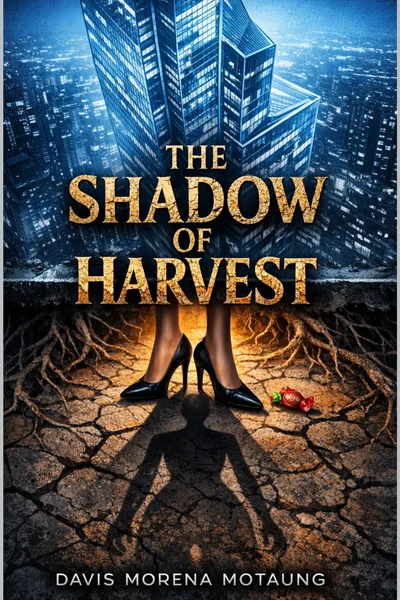
The Shadow of the HarvestDo not trade your lifelong harvest for a temporary snack; for the belly is soon empty, but the field remains barren.From the author of over 35 titles comes a haunting exploration of ambition, integrity, and the cost of the "iPhone Standard."Lindiwe Motaung is a "Master Planner" in training, a woman desperate to outrun the soot-stained memory of her father’s bankrupt repair shop and the suffocating scent of burnt copper. Determined to escape the "squeaky boot" of her humble beginnings, she enters the glitzy world of high-stakes university life and elite corporate circles.But in her rush to escape the Ghost of her past, Lindiwe finds herself trapped in a cycle of "Temporary Snacks", fleeting luxuries, hollow status symbols, and transactional relationships that offer the veneer of wealth but strip away the soul. As she navigates the "League of Intimidation," Lindiwe must decide if she is the architect of her own destiny or merely a component in someone else's machine.The Shadow of the Harvest is a gritty, visceral journey through the "Friction" of a life lived without a moral compass. It is a story for the dreamers who have felt the pressure to project an abundance they don’t possess, and for the "master planners" who have lost themselves in the service of everyone else’s joy.In this gripping narrative, you will discover:A Confrontation with Vanity: A raw look at the "Mirror of Vanity" and the grueling, beautiful process of "Messy Restoration."Stewardship vs. Consumption: A profound philosophical inquiry into what it means to build a legacy that lasts versus a life built on fleeting appearances.The Grit of Reality: A powerful, grounded prose style that captures the heat of the struggle and the quiet courage required to return to the soil and plant a tree you may never sit under.Will Lindiwe successfully trade the "iPhone Standard" for the enduring weight of integrity, or will the Shadow of the Harvest leave her fields barren forever?Step into the sanctuary. Confront the ghost. Reclaim your harvest.
Published 2026

The Hook: A Miracle Built on Debt“Love is not the price you pay for a miracle; it is the currency the dark cannot count.” Step into the Liminal Wing, a sentient hospital where medical care defies natural laws and demands a currency far more devastating than money. In this Romantasy landscape, sterile hallways carry an artificial cold, and heavy walls act as a living antagonist, watching families with hungry patience. Here, to save a dying loved one, you do not sign insurance papers. You trade your soul.The Setup: Clara’s Devastating ChoiceWhen Clara arrives at the admissions desk with her fading father, his skin is already sallowing from the Grey Decay, a smoky pallor signaling the hospital is claiming its own. The rigid clerk places an empty glass vial on the desk and issues a chilling ultimatum: the Operating Room requires a catalyst to begin, a foundation of who she is.To buy her father time, Clara surrenders her very first childhood memory, the comforting warmth of her father’s hand on her shoulder as she balanced on a blue tricycle. The memory dissolves into a golden mist inside the vial, leaving an aching, static void in her mind. A ballpoint pen clicks rhythmically (Click. Click. Click.) like a countdown timer. Her father is admitted, but Clara discovers a terrifying truth: the exit doors seal shut. She is no longer a visitor; she has been integrated into the machinery of the hospital as a "Waiter", a living battery whose emotional hope supplies the voltage for the operations upstairs.The Alliance & Climax: Defiance Over SacrificeTrapped inside the loop, Clara crosses paths with Elias, a weary mechanic in grease-stained overalls who smells of WD-40 and industrial reality. Elias moves through the facility managing the literal friction of the building. He is the architect of Relational Realism, the belief that true integrity is found in holding the line through the messy, unpolished parts of a crisis. He shows Clara the true horror of the Wing: it is an ecosystem of stagnant grief where "miracles" are merely bait to drain Waiters dry until they stop wanting, leaving the Grey Decay to devour their marrow.Bound by an intense romance operating like synchronized gears, Clara and Elias choose to stop playing defense. Descending into the humming subterranean core, they trigger a "Refund Protocol" using their true, un-commodifiable South African names: Masechaba and Thabang. By reclaiming their identities, they shatter the magical seals of the system. But a miracle born of defiance demands an anchor. To open the failsafe exit doors and release every trapped soul, Thabang must make the ultimate sacrifice, holding down a high-pressure valve from the inside as the mechanical structure collapses around him.The Resolution: The Gravity of the OrdinaryMasechaba wakes up back in the mundane, unyielding reality of a public hospital. The Liminal Wing has folded back into the seams of the world, leaving her with a recovered father who sadly no longer recognizes her face due to the permanent toll of the trade.Reunited with Thabang in the waking world, they find themselves "too thin", so fundamentally altered by trauma that the ordinary world's motion sensors fail to recognize their physical mass. In a powerful ending, they must frantically wave their arms and laugh aloud in the quiet lobby, aggressively asserting their human integrity to force the ordinary doors to open into the rain-scented night.
Published 2026
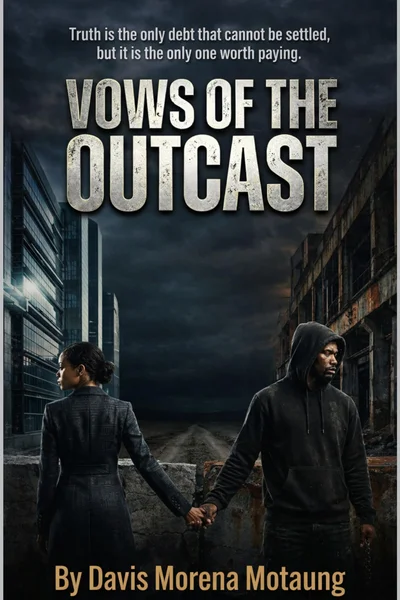
Vows of The OutcastIn a world where truth is a liability, how much are you willing to lose for your integrity?Accountability is the only currency that matters under the Ministry’s "Transparency Act," where every secret is tracked and every broken promise carries a lethal price. For a high-level analyst who has lived by the code, the discovery of a systematic erasure, a weaponized version of Statute 402, is the final catalyst for descent.Forced into a volatile alliance with a ruthless Syndicate debt-collector, our protagonists must navigate a crumbling, high-surveillance urban landscape where a single lie results in social excommunication. As the Ministry’s grip tightens and the lines between enemy and ally blur, they are forced to confront the ultimate question: when the system is designed to dismantle human connection, is rebellion worth the price of existence?A visceral, philosophical thriller that challenges the cost of integrity in a world designed to crush it.Appendix: Supplemental Lore for Vows of The OutcastI. The Syndicate CodeThe Syndicate operates not on written laws, but on the "Weight of Reciprocity." Within the underground, a promise is treated as a binding financial instrument.The Law of Totality: No debt is ever fully settled; it is merely transferred. To clear a debt is to end a relationship, an act viewed with deep suspicion by the Syndicate leadership.The Silence Protocol: Verbal agreements hold greater legal standing than digital contracts. This is designed to circumvent digital surveillance and maintain the "human signature" of their operations.Accountability Mandate: Any member who fails to meet an obligation must forfeit a "Relational Asset", a personal connection or piece of private data, which is then auctioned within the lower sectors.II. Ministry StatutesThe Ministry functions as the architect of "Ordered Reality," maintaining control through the rigid enforcement of the following statutes:Statute 402 (Data Integrity): The mandatory submission of all personal logs to the Central Archive. Any modification to these logs is categorized as "System Sedition" and is punishable by immediate social excommunication.Statute 91 (Resource Rationing): Defines the scarcity threshold for essential services, including energy and data access. Under this statute, the Ministry reserves the right to reallocate power from residential sectors to the core grid without notice.The Transparency Act: Grants Ministry inspectors full access to any private space, physical or digital, at any time to verify compliance with national stability protocols.
Published 2026

This is the story of Julian and Elena, a "Player" and a "Pursuer" trapped in a modern theater of connection where convenience is valued over character and "the thrill of the chase" masks an inability to commit.The Discomfort of the ShoeThe premise of "Trying to Fit the Shoe" is simple yet profound: the friction in our relationships is rarely a matter of incompatibility, but rather the conflict between the soul's need for a destination and the heart's fear of the distance.Elena, a brilliant strategist, lives in a world of "investment," meticulously crafting a future with Julian, a charming executive who views intimacy as an "anchor" that threatens his identity. Elena is haunted by a "Ghost", a deep-seated fear of being disposable, that drives her to over-invest in a man who prefers the "sweetness of now" over the weight of tomorrow.As they navigate the high-stakes world of corporate ambition, they are constantly "Trying to Fit the Shoe", forcing their lives into shapes that leave them bleeding.Why You Need to Read ThisThis book is not just a work of fiction; it is a mirror held up to the "Geometry of Integrity." Through the lives of Julian and Elena, author Davis Morena Motaung invites readers to confront their own "Ghosts."For the "Pursuer": If you are weary of unreciprocated effort and find yourself constantly "side-stepping" your own boundaries to keep someone else comfortable, this book provides a sanctuary and a map for your own path.For the "Player": If you are tethered to the fear of being seen and find yourself using charm as a shield against true intimacy, this work offers a mirror to the cost of your detachment.A Revolution of the SoulThis is not a story about finding a "perfect fit." It is a story about the heavy, necessary work of self-stewardship. It challenges the culture of instant gratification and encourages readers to stop trying to fit into worlds that require them to cut away pieces of their own integrity.Whether the "shoe" is the wrong size or you are simply afraid to walk the distance, this book will challenge you to have the courage to walk barefoot until you find your own ground. It is an invitation to stop seeking validation on the "Surface" and start building a life on the "Skeleton" of your own truth.Are you tired of forcing a fit? Discover why the most profound tragedies aren't in the parting of ways, but in the slow erosion of the self."Trying to Fit the Shoe" is a revolution of a soul finally coming home to itself. Pick up your copy today and begin the journey toward true restoration.
Published 2026
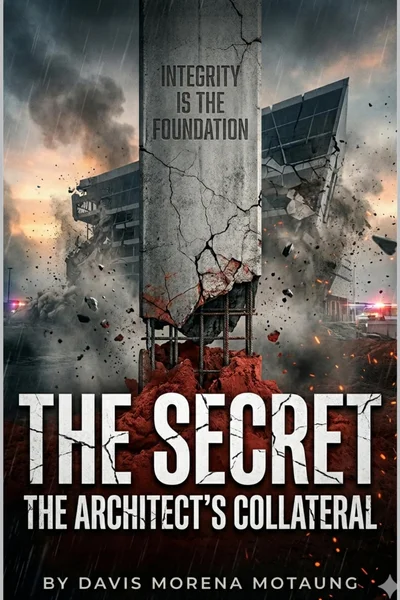
No description available.The Sanctuary is Built on a Lie. The Foundation is Cracking.Thabo Godfrey Motaung is the pride of Vosloorus, a celebrated author, a trusted counselor, and the visionary architect behind the city’s crowning achievement: a sprawling youth sanctuary built on the promise of "Absolute Accountability." To the community, he is a beacon of integrity. But to Thabo, he is a man trapped by a decade-old secret buried in the red mud of the construction site.When a ruthless antagonist, the keeper of the "Shadow’s Debt", threatens to exhume the past, Thabo’s carefully curated world begins to crumble. Thrust into a high-stakes game of moral extortion, he is forced to betray the very people he swore to protect to keep his own hollow cornerstone from shattering.As a persistent journalist closes in and the physical structure of the center begins to fail, the walls start to weep. Thabo realizes the devastating truth: he hasn't been building a sanctuary; he has been maintaining a beautifully decorated cage.
Published 2026

The House of Quiet Waters: A Psychological DescentOn a windswept, salt-sprayed coastal cliff, a man attempts to dismantle the architecture of a fractured existence. The House of Quiet Waters is an atmospheric, psychological drama that probes the brutal intersection of memory, environment, and the unyielding weight of the past.The Narrative ArchitectureFollowing a retreat from the suffocating pace of Johannesburg, the protagonist seeks refuge in a home designed for erasure rather than habitation. Within these walls, the external world begins to merge with his internal history. Utilizing the author's unique philosophy of "Relational Realism," the house functions as more than a setting; it is a silent, imposing interlocutor that forces the protagonist to confront the specific "absences" he has spent a lifetime curating.Across a meticulous 49-chapter roadmap, the boundaries between the reality of the coastal landscape and the specters of his previous life begin to fracture. The protagonist engages in a process of dismantling his history, transforming the house into a laboratory of truth where every object, shadow, and sound serves as a testament to the life he is desperately trying to outrun.Key Thematic ElementsThe Architecture of Memory: The novel posits that our environments are mere extensions of our internal states. The house, with its deliberate design and imposing geography, forces the protagonist to interact with his psyche in a tangible way.Tactile Realism: Drawing on a rigorous aesthetic of chiaroscuro and visual hierarchy, the prose grounds the reader in sensory details, the bite of salt-crust, the sterile hum of a stainless-steel shredder, and the jagged beauty of kintsugi lacquer.The Pursuit of Integrity: The journey from the prologue’s "Architecture of the Ledger" to the finality of the epilogue is a slow-burn descent into the heart of a man who realizes that some pasts cannot be shredded, only inhabited.Why Read This?The House of Quiet Waters is crafted for readers who value atmosphere, deep psychological tension, and structural precision. This is not a story of easy answers or hollow resolutions. It is a masterfully paced drama that demands the reader navigate the thin line between the life left behind and the silence that remains.Lore Documentation: The "Relational Realism" FrameworkThe foundation of this narrative is built upon the author’s proprietary philosophical framework, Relational Realism, which asserts that no individual exists in a vacuum; rather, they are defined by the objects, spaces, and histories they inhabit.The Interlocutor Theory: Physical space is an active participant. The house does not just "contain" the protagonist; it responds to his thoughts, creates barriers to his progress, and archives his regrets.The Singular Anchor Rule: Every sequence in the 49-chapter architecture is tethered to a "Singular Anchor", a specific physical object or environmental detail that grounds the psychological drift.Chiaroscuro Narrative Pacing: Inspired by the mastery of light and dark, the story ensures that moments of extreme emotional exposure are always balanced by the cold, heavy reality of the protagonist's past.The House of Quiet Waters is a profound meditation on what occurs when the architect of your own life decides to tear down the walls. Immerse yourself in a narrative where the architecture of the past is the only thing standing between you and the truth.
Published 2026
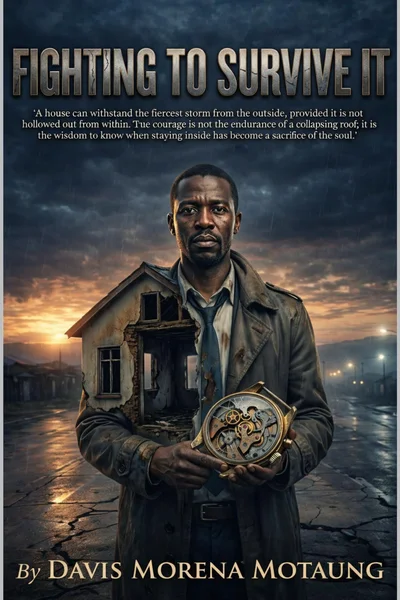
The Lore Document: Crucial Rules of the UniverseTo truly understand the stakes of Fighting to Survive It, readers must understand the unique laws that govern its world. This is not a story of random tragedy, but a universe built on the principles of Relational Realism.The Law of Inside-Out Decay: In this world, physical structures, homes, streets, and entire communities, are emotionally reactive. A building cannot be destroyed by external storms alone; it only collapses when it has first been hollowed out from within by unaddressed human compromises, silence, and a failure of accountability.The Trap of False Endurance: Society teaches that surviving under a collapsing roof is a sign of strength. The lore of this world counters that belief: true courage is not enduring a toxic reality, but possessing the wisdom to leave before staying requires the absolute sacrifice of your soul.The Chronos Anchor: The open, exposed clockwork gears carried by the characters represent the heavy, mechanical weight of time. It symbolizes The Internal Audit, the inescapable moment a person is forced to look at the raw mechanics of their choices and count the true cost of their self-deception.Comprehensive Book Summary & DescriptionTitle: Fighting to Survive ItAuthor: Davis Morena MotaungGenre: Literary Drama / Psychological Fiction / Relational Realism"A house can withstand the fiercest storm from the outside, provided it is not hollowed out from within."The Narrative ArcSet against a backdrop of fracturing landscapes and gathering storms, Fighting to Survive It follows a powerful, character-driven journey of psychological survival. The narrative strips away the comfort of easy answers, forcing its protagonist to carry the visible weight of his ruined private life into a harsh, unyielding public sphere.When the foundational contracts of his relationships and his environment begin to cleave underfoot, he is forced to face the exposed gears of his own life. It is a visceral exploration of the boundary between resilient endurance and total self-destruction.
Published 2026
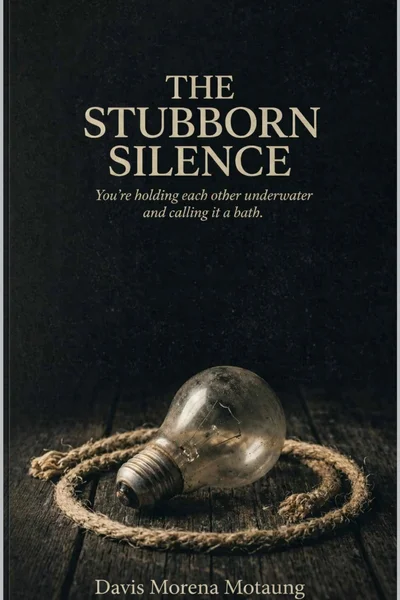
Are you holding your marriage underwater and calling it a bath?In the quiet suburbs of Ekurhuleni, a husband and wife have built a fortress. They call it peace. They call it loyalty. They call it protection. But to the rest of the world, it looks exactly like a tomb.The Stubborn Silence is a gripping, evocative work of "Relational Realism" that peels back the layers of the "Defensive Pact", a dangerous, unspoken agreement where two people use their devotion to justify standing still while the world moves on without them.The StoryIt begins at 6:14 PM with a flickering lightbulb that finally surrenders to the darkness. Instead of fixing it, the couple chooses to stay in the gloom, convincing themselves that the "distractions" of the world are simply not worth the effort. Slowly, their home becomes a labyrinth of "no-go zones": the hallway where the light died, the kitchen where they avoid the noise of the microwave, and the porch where the weeds are beginning to reclaim their doorstep.As their physical world shrinks, their internal world hardens. They construct a "Love Mask", a complex web of polysyllabic excuses and linguistic evasions, to shield each other from the mounting debt of a life left unlived. But the world has a way of intruding. Silas, their eighty-year-old neighbor who lives in the "mud" of the world, becomes the catalyst that threatens to shatter their fragile, airless sanctuary.Why You Must Read This BookThe Stubborn Silence is not just a story; it is a mirror. Davis Morena Motaung, a pastor and counselor, masterfully explores the moral weight of our choices. He asks the questions most are too afraid to voice:At what point does "loyalty" become a suicide pact made of kindness?How much of our "peace" is just a refusal to face the friction of existence?What is the true, physical cost of standing still?Through haunting prose and intense emotional stakes, this narrative forces you to look past the thematic explanations and witness the consequences of a life left unlived. From the flickering hallway light to the weeds reclaiming the porch, these pages will challenge you to choose the "friction" of a lived life over the sterile safety of a tomb.
Published 2026
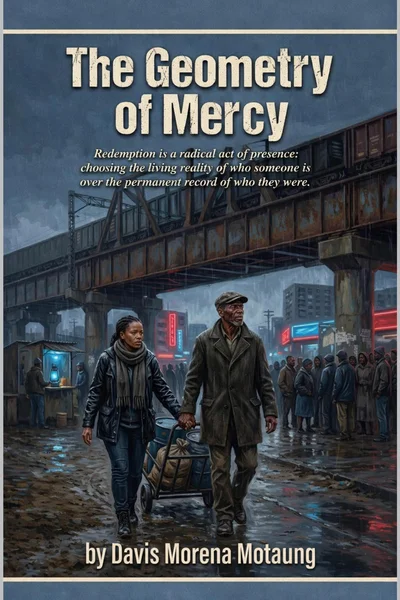
The Geometry of MercyRedemption is a radical act of presence: choosing the living reality of who someone is over the permanent record of who they were.SynopsisIn the unforgiving grid of a city built on brutalist stone and algorithmic judgment, data is destiny. Under cold neon lights, a person's life is permanently indexed; the state flatly refuses to recognize the quiet architecture of a changed human heart. Survival demands absolute compliance, and the concrete seems to drink the record of every human failure.David Mokoena is a man suspended between chapters, carrying the rotting corpse of his yesterdays. A decade ago, he was a licensed regional consultant who signed execution orders cutting off vital heating allowances for thirty vulnerable families in the lower Vosloorus perimeter. When the system turned its cold, administrative eye on him, he became the ultimate scapegoat, stripped of standing and cast into permanent social exile. His reputation became an independent entity, a digital ghost arriving in every room before his physical body could cross the threshold. He has locked his survival mask into place, accepting his condemnation as absolute math.Everything changes when his trajectory collides with a fierce, deeply principled community strategist at a failing, unheated neighborhood center marked for erasure. To her, it is a sovereign sanctuary where human value is never determined by a background check. Operating in the messy, unpolished gray spaces of Relational Realism, she treats compassion not as a soft virtue, but as a gritty, structural rebellion against institutional cruelty.When the board detects David, they issue an ultimatum: cast out the anomaly, or drop the community's heating to zero. As winter fog rolls in, the past takes physical form. Marcus, a cold administrator from David's former life, arrives to weaponize the historical archive. Together, they must risk safety profiles, bypass checkpoints, and manually push distribution carts into the biting frost to keep the block alive.Structural Lore & Core ThemesThe Architecture of the Ledger: A hyper-perceived digital infrastructure that permanently indexes every human mistake, enforcing public exile through tracking signals and sudden drops in ambient volume.Relational Realism: Grounded in human integrity, the narrative explores how true human restoration cannot be computed by a data schema, directly contrasting institutional prejudice with the high-stakes demand of radical presence.African Dark Academia: Set against an atmospheric, winter-bound Vosloorus landscape, weaving heavy brutalist imagery, low-lying fog, and sharp neon lines into a philosophical exploration of guilt and spiritual rebellion.The Weight of the Grip: Symbolized by self-neglect and the rough texture of coarse wool, characters grapple with the deep psychological wear of the masks they wear to survive.About the AuthorDavis Morena Motaung is an author, editorial strategist, and organizational psychology consultant based in Vosloorus, South Africa. Since beginning his literary journey in January 2014, he has authored a prolific catalog of over 35 books spanning multiple genres. His work explores the gritty intersections of human accountability, grace, and spiritual integrity, operating under his distinct creative framework of Relational Realism. The Geometry of Mercy stands as a powerful fictional sanctuary for anyone who has ever felt reduced to a past chapter.

A Total Eclipse of the Heart. A Resonance of the Soul.In the vibrant but dusty township of Vosloorus, South Africa, two broken spirits are "standing in the shadow" of lives they no longer recognize.Amara is a gifted artist who has retreated into an "altar of silence". Since the sudden loss of her fiancé, her canvases have remained unfinished, and her world has faded into a landscape of "terracottas and deep browns." She is a woman waiting for a light she fears will never return.Luthando is the "master of the mask." To the neighborhood, he is the man with the "too loud" laughter and the quick joke. But behind his cynical resilience lies the "ghost of betrayal", an empty home and a heart hollowed out by a devastating deception.When the Sun Goes Dark, the Music BeginsAs South Africa prepares for a literal, once-in-a-lifetime solar eclipse, the community of Vosloorus gathers to find its "collective heartbeat". Under the guidance of the wise Grandmother Thandi and the visionary choir director Malusi, Amara and Luthando are pushed into a reluctant collaboration.Through the "Hymn of the Returned Light," they discover a "universal resonance" that neither could find alone. But the path to healing is not a straight line. It is a "shadow dance" of:The Pull and Push: The terrifying intimacy of being "actually there" for another person.The Anatomy of Trust: Learning to distinguish between the "memory of love" and the "gravity of the past."The Moment of Totality: A visceral confrontation with their deepest fears during the literal darkness of the eclipse.Why You Should Read Eclipse of Two Hearts:Cinematic Imagery: Experience the "bruised indigo" skies and the rhythmic pulse of South African township life.Emotional Depth: A powerful exploration of "liturgical grief" and the "radiant redemption" that follows.Spiritual Resonance: A story about how we are all "participants in a renewal", proving that the light is never truly gone, it is just waiting for the moon to move.Will Amara and Luthando remain "two strangers bound by the same celestial theft," or will they find the courage to "shine together" in the eternal dawn?"A breathtaking journey through the anatomy of grief and the miracle of the duet. This book is a 'must-read' for anyone who has ever searched for meaning in the shadows".
Published 2026
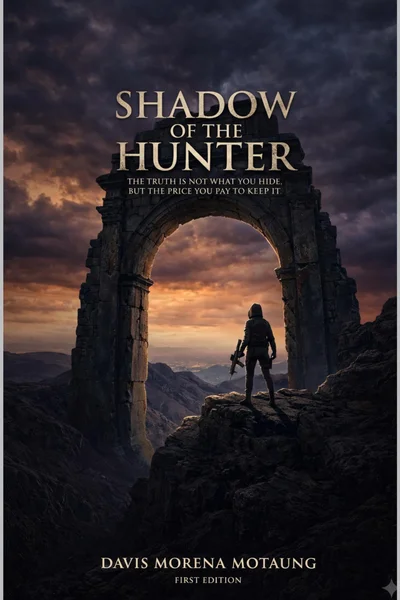
The truth is not what you hide, but the price you pay to keep it.Shadow of the Hunter is a high-octane psychological thriller that pulls the curtain back on the invisible structures of control shaping our modern world. In a city of golden lights and hidden fractures, Johannesburg serves as the backdrop for a war fought not with soldiers, but with data, leverage, and the cold, surgical precision of the global grid.The PremiseIsabella, an architect of the invisible, spends her life stabilizing the balance of powerful firms through clinical manipulation. She is a master of unraveling, navigating the friction between her public persona and the woman she desperately tries to protect within herself. But her carefully constructed life is shattered when a routine job leads her to the Black Ledger, a repository of untraceable transactions and secrets that holds the leverage over those who believe they are untouchable.When her cousin, Naledi, accidentally stumbles into the middle of a high-stakes heist, she becomes a target in a game she doesn't know how to play. To save her, Isabella must abandon the life she built, forcing them both into a relentless, global pursuit that spans from the windswept cliffs of Cape Town to the industrial shadows of Lagos, Nairobi, and beyond.A New Literary FrameworkMore than just a narrative of pursuit, this story is a manifestation of Relational Realism. It explores the "Black Ledger" of our own lives, the moral toll we pay to survive in an increasingly mechanical age. As an author and counselor, Davis Morena Motaung weaves a tale that serves as a mirror for accountability, challenging readers to consider their own "daily, grueling negotiation with one’s own conscience".Why You Need To Read ItHigh-Stakes Tactical Action: Experience breathtaking chases, from motorcycle pursuits along Chapman’s Peak to intense combat on cargo vessels, all written with the surgical precision of an insider.Deep Psychological Depth: This is not your standard thriller. It is a story about the friction between duty and desire, and the realization that the most dangerous secrets are not the ones we keep from the world, but the ones we hide from ourselves.A Timeless Question: In an era where data replaces depth, can we remain human? Follow Isabella and Naledi as they move from the role of the hunted to the architects of the system’s collapse, proving that the only way to beat a rigged game is to understand the code that powers it.If you are a fan of high-stakes conspiracies, complex moral dilemmas, and characters who are forged, not born, through the fire of their own choices, Shadow of the Hunter is your next essential read.Step away from the mechanical noise. Confront your own shadow. Join the pursuit for the truth that can no longer be hidden.
Published 2026

Adrian is a high-status "Image Architect" who has mastered the art of the Veneer. His life is a curated masterpiece, anchored by his wife, Selene, a woman of such Radiant beauty that she serves as a Perceptual Shield, blinding Adrian to the structural rot within his own home.He lives the Double Shift: working tirelessly to fund a luxury lifestyle while simultaneously laboring to maintain the illusion of a perfect marriage. But behind the gala invitations and bespoke suits, the Architecture of Decay is accelerating.When the Great Collapse inevitably occurs, Adrian finds himself the Last to Know of a betrayal that spans years and fortunes. Stripped of his status and his "Petal," he is forced into a brutal Spiritual Audit.The JourneyThe novel follows Adrian’s descent from the skyscrapers of the elite into the Geography of Loneliness. It is here, in the "Wilderness," that he stops being a victim and starts becoming an archaeologist of his own soul. He discovers the Shared Guilt of the mirage, realizing that his obsession with aesthetic perfection made him the co-architect of his own destruction.The ResolutionThis is not a story of revenge, but of Redemption through Reality. Adrian emerges not with a new mirage, but with Integrity. He learns the ultimate lesson of Moral Realism: that a masterpiece is fragile and easily shattered, but a survivor, etched with Scars, is unbreakable.The story concludes in the Garden of Agape, where the "Physics of Surface Love" are replaced by a profound, healing truth: The scar teaches what the petal cannot.Why You Should Read ItA New Vocabulary: It moves beyond clichés to explore "Financial Necrosis," "Domestic Neglect," and the "Vow of the Blind."Psychological Depth: It explores the "Anatomy of the First Bloom" and why we choose to stay blind to the truth.Provocative Philosophy: It challenges the reader to look at their own life and ask: Am I loving the image, or the truth?
Published 2026
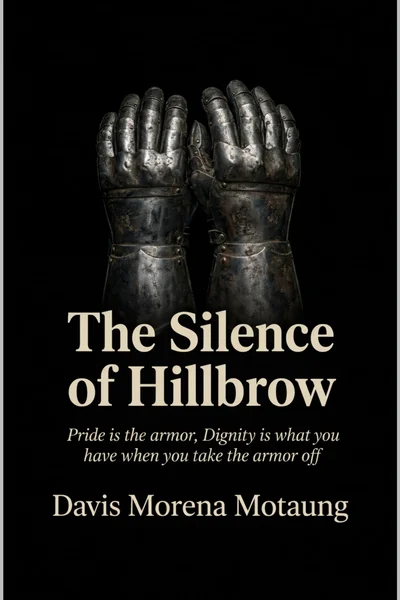
The Silence of HillbrowThe Silence of Hillbrow is a gripping exploration of social realism and institutional decay, masterfully woven through the lens of Relational Realism. Set against the stark, shifting landscape of urban South Africa, the narrative peels back the layers of a society built on the fragile intersection of personal accountability and systemic failure.SynopsisThe story follows two protagonists, Sipho and Naledi, as they navigate the suffocating constraints of an environment where silence is not merely a choice, but a survival mechanism. As they grapple with the collision of their personal lives and the broader socio-economic pressures of their community, they find themselves caught in a complex web of complicity and struggle.The narrative does not offer the comfort of a clean resolution; instead, it demands that the reader confront the uncomfortable truths of integrity in an age of moral compromise. By utilizing the Windowpane Principle, the prose remains accessible and globally resonant, ensuring that the local struggles of Hillbrow translate into a universal human experience of accountability and endurance.Core ThemesSystemic Integrity: The book interrogates how institutional corruption erodes the moral fabric of individuals and the communities they inhabit.Relational Realism: Character arcs are guided by the "Relational Realism" framework, ensuring that choices are never binary but are instead deeply embedded in the complex, flawed, and often painful reality of human relationships.Human Accountability: Through a 49-chapter structure, the manuscript tracks a journey of self-reflection, forcing the characters to face the consequences of their actions in a world that often rewards silence.The Weight of Place: The setting of Hillbrow acts as a silent character, mirroring the internal degradation of the protagonists and highlighting the stark contrast between the illusion of order and the reality of the streets.The Human SignatureAdhering to the author's unique "Human Signature" editing rules, The Silence of Hillbrow avoids the polished, artificial flow common in contemporary automated literature. The narrative features natural dialogue imperfections and punchy, short sentences that keep the tension taut and the characters grounded. There are no easy endings here, only the quiet, often sobering reality of lives continuing in the wake of immense systemic pressure.The Silence of Hillbrow is a profound, unflinching look at what it means to remain honest in a world that asks you to look away. It is essential reading for those who seek fiction that challenges the status quo and treats the human condition with raw, unfiltered complexity.
Published 2026
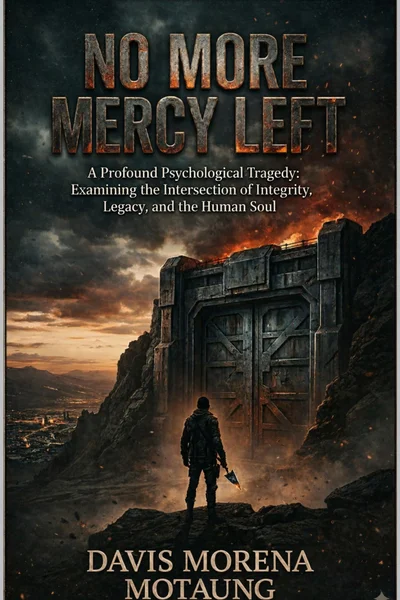
No More Mercy LeftTo kill the monster is to inherit his shadow; to claim the throne is to bury the man.Elias thought he had successfully buried his past. In the quiet township of Vosloorus, South Africa, his life is defined by simple, grounding rhythms: the comforting scent of neighbor’s lavender detergent, the morning chorus of garden birds, and the rich grit of the garden soil beneath his fingernails. For the retired counselor, this domestic sanctuary is a sacred pact made with the earth, a hard-won peace where his high standards are reserved for pruning rosebushes, not surviving crossfires.But a legacy built in professional shadows is a parasitic twin that refuses to die.The fragile status quo shatters when Marcus Vane, a powerful figure from a ruthless global Syndicate, steps out of an expensive sedan and onto Elias's porch. Vane brings an invitation to dismantle a chaotic northern territory, leaving behind a custom .45 ACP casing on the kitchen table, a chilling clinical signature of things to come. Elias flatly refuses, choosing his garden. But the Syndicate doesn't accept a quiet retirement.Hours later, the stillness of the evening is brutally obliterated. In a calculated, high-velocity execution, Elias’s home is breached, and his family is slaughtered among the ruins of his living room. Staged clues point directly toward the northern gang. Blinded by grief and driven by a meticulously calibrated "False North" narrative, Elias sheds the peaceful counselor and steps back into the skin of the Navigator, a lethal, machine-like tactician.Re-forging his identity, Elias sharpens his heavy-duty gardening trowel into a surgical wedge and twists trellis piano wire into a deadly garrote. He sets out on a scorched-earth path of vengeance across the stark architectural contrasts of South Africa, from the gritty township streets to the high-end, polished marble fortresses of Johannesburg’s northern suburbs. To hunt down the architects of his ruin, Elias must systematically hunt and audit the Syndicate’s Seven Links: The Architect, the Archivist, the Ghost, the Chemist, the Oracle, the Priest, and the Mirror.But every step along this cold trail of blood is a brutal test of the human soul. As the external war rages and bodies fall as silent signatures of a relentless logic, Elias’s internal integrity is scraped raw. He is trapped in a devastating trap of "Hollow Succession," moving forward with a reluctant competence, only to realize too late that he is destroying an innocent party under a beautifully orchestrated lie.In a visceral, atmospheric descent where the lines between justice and monstrosity completely dissolve, Elias faces an ultimate confrontation in a remote mountain fortress. To claim his vengeance and take the throne of the empire that broke him, he must survive his own terrifying reflection. But as the fire catches up to the truth, a haunting question remains: What luxury is a crown of bone and mercury when the mercy has finally run dry?Perfect for fans of gritty psychological thrillers, social realism, and complex anti-heroes, No More Mercy Left is an intense, atmospheric masterclass in tension, exploring the heavy, tragic cost of losing one's humanity in the name of survival.
Published 2026
2 of 2 #1.98
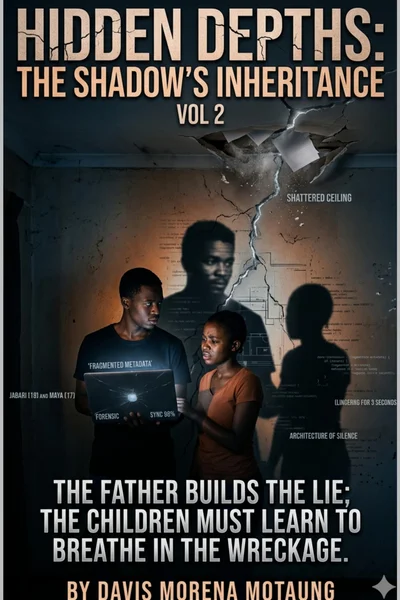
Hidden Depths: The Shadow’s Inheritance Vol 2 by Davis Morena Motaung is a "Relational Realist" psychological thriller that explores the "Inheritance", the heavy, contagious weight of unaddressed sins left for the children of a man who built his life on a lie. Following the "Great Unveiling" of their father Godfrey's secret life in Volume 1, siblings Jabari and Maya find themselves living in the ruins of his collapsed legacy in Vosloorus, South Africa.The Manifestation of the InheritanceThe story begins with a shift from psychological burden to physical contagion. The family home becomes a "museum of unaddressed sins," where the "Sensory Noise" of their father’s absence is deafening. The magic of the shadow evolves into a somatic infection:The First Shadow Leak: Maya discovers that her shadow is beginning to behave independently, lingering on walls for seconds after she has left a room.Archival Dread: Assisted by Elena, an organizational psychology consultant, Jabari begins decrypting Godfrey’s "Digital Ghosts", encrypted drives that contain the "Geometry of Integrity" he violated.The Contagion Protocol: The "Weight" spreads to the community of Vosloorus. Neighbors who helped maintain Godfrey’s silence begin to exhibit graying skin and heavy, independent shadows.The Shattered Ceiling and the VaultAs the siblings begin to "re-author" their past, the house physically disintegrates. A "Shattered Ceiling" manifests as a literal crack above Godfrey’s old chair, widening as more secrets are uncovered. Realizing the house will swallow them if they do not finish the audit, Jabari and Maya travel to "Ground Zero", the St. Jude Archive, and eventually a hidden sub-basement "Vault" in a city skyscraper.In the Vault, they encounter a "Digital Ghost" of Godfrey’s ego and a massive, formless entity representing the collective Motaung debt. Through a "Forensic Sync," they discover the "Structural Flaw" is generational: their great-grandfather had signed a "shadow-contract" in 1924, trading the integrity of his descendants to survive a famine.The Architecture of ReparationThe siblings realize they cannot delete this history but must instead "name the debt". They engage in the "Architecture of Reparation":Humanization Protocol: They return metadata to the community, admitting the truth to those Godfrey "deleted" to build his kingdom, such as their neighbor Mr. Magagula.The Covenant of Dust: They travel to their ancestral village in the North West to close the ledger. By settling the account at a communal tap, they clear the "Contagion" for the entire community.Conclusion: The New FoundationThe novel concludes with the total destruction of their physical inheritance; their wealth is gone and their house is "a hole in the ground". However, by breaking the "Double Bind" of blood and refusing to be "architects of the void," Jabari and Maya find "The New Foundation". Maya emerges as the "architect of her own integrity," standing on solid ground while "heavy with truth".Key Characters:Jabari Motaung: A student of organizational psychology who becomes a "forensic investigator of his own soul" to track the contagion.Maya Motaung: Godfrey’s daughter, who develops the ability to "read the weight" and see the structural flaws and unaddressed sins in others.Godfrey Motaung: The deceased "Shadow’s Architect" whose digital and somatic legacy haunts his children.Elena: A consultant who provides the "Technical Grit" needed to decrypt the family's digital ghosts.
Published 2026

Hall PassIn the High Citadel, no stars burn brighter than Kaelen Thorne and Elara Vance. Kaelen is the Golden Paladin, a legendary hero whose nature magic can heal the earth; Elara is the High-Architect and Corporate Mage, a brilliant mind who engineers reality itself into shimmering crystalline structures. As the "Power Couple" of the age, they represent the pinnacle of success and status.The Gilded Cage and the Hall PassBut behind their public "Victory Toasts" lies a dark secret. To cope with the crushing pressure of their legendary status, Kaelen and Elara grant each other a "Hall Pass", a secret "don’t ask, don’t tell" pact to escape into substance abuse. This agreement allows their "Shadow Selves" to take control, transforming their once-divine magic into something terrifying:Withering Magic: Kaelen’s life-giving nature magic curdles into a necrotic force that rots everything it touches.Shatter Magic: Elara’s perfect geometric matrices become jagged, volatile, and destructive shards.The Ancestral Rock BottomThe facade eventually crumbles into a "Two-Weather House," where their children are forced into "parentification," cleaning up the wreckage of their parents' magical outbursts. Their professional decay leads to a public "Social Death," as they are stripped of their titles and magic, eventually losing everything to "Enabler Villains" who exploited their addiction.The Courage to be OrdinaryThe novel culminates in the "Null-Zone," a place of absolute silence where they must face the "Shadows" without the crutch of magic or status. Reclaiming their lives requires a "Permanent Sacrifice", burning their thrones to save their family."Hall Pass" is a powerful testament to the "Covenant of Presence," suggesting that the most legendary act of all is not shattering worlds, but the courage to be ordinary, sober, and present.
Published 2026
Showing all 20 books